Top 10 Wordle Openers in 2026 (Ranked by Data)
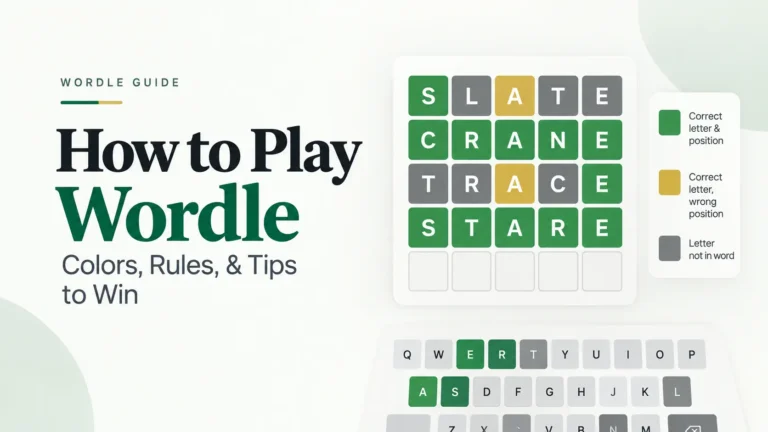
Not sure which word to use as today’s opener? Compare TRACE, CRANE, and SLATE based on the ranking data, and learn letter-frequency logic and two-word openers in this guide.
Why Wordle’s First Guess Matters
Consider the first guess as a scouting run, not a direct attempt to solve the game. It is meant to test the board and squeeze clues. A strong opener trims the official answer list, whereas gentler options leave the player with hundreds of options in play.
In Wordle answers, the letter E appears far more often than others. Around 46% of answers contain E, followed by A at two in five, R at 34%, and O and T at around 29%. The letters like S, L, I, N, and C move into the next tier to fill the gap. Connect the dots using the letters from the cluster. Even if all tiles end up grey, you can still kick out five letters from your guesses and save attempts.
Where the letter sits also counts. In most answers, S covers the first slot, and E targets the last. Once you put high-frequency words in the best possible seats, the green, yellow, and grey tiles reveal clues and shrink the candidate pool. To spend the colors statement carefully, walk through the Wordle Strategy Guide. For help with today’s puzzle, explore our Wordle hints today before revealing the answer.
10 Best Wordle Starting Words – by Data
The data mentioned below reflects algorithmically estimated answers left after the best opener. Aim to use the openers as a comparison, not a promised answer.
SALET
71 leftThis is an excellent choice to test the five letters as in the opening guess. Based on its letter frequency, it wins computer rankings. However, SALET is an obscure word used for a medieval helmet.
SLATE
78 leftSLATE follows the same frequency as SALET with a familiar letter pattern. It brings together two vowels and three common consonants. Players sacrifice a little statistical edge for a replacement opener they won’t forget. A default recommendation for those who seek near-max efficiency.
CRANE
82 leftSee, two vowels and three consonants make the CRANE a wonderful choice for an opening guess. Highlighted by the New York Times analysis, it is a popular pick because the R takes center stage with 34% of answers, and the rest of the letters buy a beautiful blend of letters.
TRACE
84 leftNear twin to CRANE with a subtle shift in letter placement. Moving the letters gives you a handy way to turn tiles green. Once you get an appropriate first opener, you can use this word family ending in -ACE, ATE, -ARE to complete the task.
CRATE
86 leftCRATE overlaps heavily with TRACE; the letter E was shuffled to its favorite ending spot. A slight difference makes these two options a good choice as a starting point, even though you can rearrange the word on your own.
STARE
88 leftAs we discussed earlier, S is the best opening letter, as seen in STARE. In contrast, the E at the end shows another word ending in E; in the full plausible answer list, both placements are equally available, giving the best coverage.
RAISE
91 leftRAISE puts three vowels and becomes a high-frequency vowel word. If you don’t want to abandon consonants quickly, opt for RAISE to test vowels first.
AROSE
93 leftThis vowel-frequent word leans on the vowel set but shuffles the O with I. When your first row reveals mostly grey tiles, pair it with A consonant-rich second guess.
ADIEU
110 leftDon’t you think it’s a second-to-none vowel probe that lightens up four vowels at once? You can use ADIEU as a vowel probe to narrow down vowel-containing word possibilities. Instead of less-frequent vowel words, try ADIEU as a standalone leaderboard.
ROATE
85 leftROATE’s major drawback is its obscurity. By contrast, it is considered one of the most efficient Wordle openers, with a common vowel-consonant pattern. Wordle boards prefer it, while armchair solvers usually don’t. Instead, factoring in SLATE, CRATE, and TRACE.
Best Starting Words by Strategy Type
Different openers aim to different purposes. Curious which vowels are part of today’s puzzle? Try ADIEU and RAISE, vowel-probe words, for a quick answer. After this search, your second guess would carry most of the load with a consonant-rich second guess.
Want to test consonants first? High-frequency consonants like BLAST, STERN, and CLUMP buy four consonants and one vowel. This approach is not recommended as an opener word but gives the most for a second guess.
Well-rounded openers are SLATE, CRANE, TRACE, CRATE, and STARE. Players who look for self-contained openers can try these options since they carry two vowels and three consonants at once. That structure is what solvers prioritize. Plus, it is also used in the Wordle strategy Guide
How to Choose a Strong Starting Word?
Four properties keep bad filters separate from mediocre ones.
High Frequency Letter
Imagine you are searching for an opener; your first row must include at least 4 common letters from the top 10 list. It includes A, R, O, T, S, L, I, N, and C. Once you get a word with four letters from this list, it becomes easier to pinpoint the answer.
Unique Letters
Don’t burn a slot by testing the same letter twice. Most common words with repeated letters are SPEED, LEVEL, and VIVID. The five letters on each tile reveal some information; instead of spending guesses, save them by repeating the letter.
Balanced Letters
If you want to save attempts, a balanced equation is the sweet spot because two vowels and three consonants give a word a perfect balance. It helps you identify vowel placement in a word and filter consonant data.
Letter Placement
Once you put a known letter in its exact place, you gain an edge. Giving S seat 1 and E 5th seat reflects that the green and yellow codes are informative enough, rather than putting the letters in low-value seats, which gives almost nothing.
Two-Word Combinations
Many players use a deliberate strategy and a fixed pair of starting words to gather useful information. The purpose of two-word combinations is to gather enough useful information by testing ten letters, not to solve the puzzle.
Four vowels and six consonants in two words: SLATE + CORGI.
CRANE + LOUDS (C, R, A, N, E, L, O, U, D, S) letters show similar coverage but with different letters.
The best elements are ADIEU + STORY. Covering all vowels and 5 consonants.
The catch of the fixed pair comes when the player completely ignores the green squares’ feedback. The preset word ruins the chance to win the puzzle in two rows, especially when your first opener gives three green tiles. That’s why players let the first guess shape the second move, adjusting their strategy based on the opener as they build the second row. Getting confused with colors and rules? The How to Play Wordle guide uncovers all the facts and rules.
Guesses to Avoid as Starters
Rare Placements
Want to know which letters are used rarely in Wordle? Some letters appear far less often, and if you build an opener around them, you’re wasting a guess. For example, Z appears 1.5%, X 1.5%, Q 1.3%, J 1.1%, and V 3.5%. Such letters leave a player in the dark.
Duplicates
Another trap in the puzzle comes from repeated letters. Once you test a word with duplicates, it misses the room for one letter and tests only four. For instance, SPEED tests four letters; LLAMA covers only three. Therefore, it is best to choose a starting word with different letters.
Proper Noun & Abbreviations
Instead of wasting guesses on abbreviations, proper names, and slang words, use a solid diagnostic strategy. These words aren’t included in the official board game or in valid word vocabulary.
Change the Risk Profile with Hard Mode
Hard mode in the Wordle puzzle made players follow all clues or guesses in subsequent attempts. For example, a green letter should stay in its locked position, and a yellow letter needs to move to a new spot. This way, exploratory guesses are no longer an option, and only diagnostic attempts help you solve the puzzle wisely.
Top-notch starters for hard mode are the same openers: STARE, CRANE, TRACE, and SLATE. Vowel-heavy words like ADIEU may dump you here. So, if you try vowels without learning consonant context, you will be left with dozens of arrangements that follow the same design.
Be mindful of soft opens that open multiple valid possibilities. If your starting clue reveals \_A_E, you’ll likely search for BAKE, CAKE, BASE, BARE, and CARE; this family of words limits exploratory choices.
Frequently Asked Questions
01
Which one is considered the best Wordle starting word?
SLATE is the top choice of players and is considered the best algorithmic solver. It shrinks the answer pool to 71 possible words on average.
02
Can I use the same word for every day’s Wordle?
Using the same words daily helps build a pattern-recognition habit. Players in hard mode often stick to one opener, typically SLATE, CRANE, or TRACE. Over time, they build muscle memory for pattern recognition.
03
Is ADEIU smart enough as a starting word?
It comes under the vowel radar, so yes. However, as a complete vowel-consonant plan, it’s a big no. Its trade-off is that it lacks consonants. The best strategy is to pair it with words like STORY and CLUMP in your second guess.
04
How many letters should your opener share with the answer?
The best starter usually shares two or three common letters in the answer. We need to search more. If you find zero, be happy because five letters left the board.
05
Does the starting word carry importance in hard mode?
Absolutely, it matters because confirmed letters box you in. A vague starting guess puts you in a pool of diverse possible words that fit the same template. Settling on balanced openers like SLATE, CRANE, and TRACE is the optimal choice.
06
Which two-word combinations cover more letters?
ADIEU followed by STORY puts all standard vowels to the test in one attempt alongside five consonants. Another fantabulous example is SLATE followed by CORGI, which tests ten letters across six consonants and four vowels. This combination of two words is a great pairing for vowel recognition.